Thursday, 2 July 2015

Nuclear Attack on Mars

Recently I've been reading about the evidence that a nuclear attack occurred on Mars. And it looks like its intention was to wipe out an intelligent civilisation on the planet.

According to Dr John Brandenburg, a plasma physicist, there is strong evidence to suggest that there were at least two nuclear explosions on the planet's northern hemisphere. The Martian surface is covered in a thin layer of radioactive material, including uranium, thorium and radioactive potassium, which radiates from those northern locations. His research is based on observations made by NASA's Mars Odyssey spacecraft.

Location of nuclear explosions on Mars

Dr Brandenburg's book on this subject, titled 'Death on Mars: The Discovery of a Planetary Nuclear Massacre' was published earlier this year.  I have yet to read it, but the ideas reportedly put forward in it are fascinating and I've put the book at the top of my 'must read' list.

The attack is said to have wiped out all intelligent life on Mars, which was likely, Dr Brandenburg says, to have advanced to the level of the ancient Egyptian civilisation on Earth. But why would the attacker deem such a relatively primitive civilisation a threat?  It would have been no where near the point of developing weapons of mass destruction or spaceflight capabilities. I think it's more likely that the civilisation on Mars had become very advanced, and quite likely had exceeded our own level quite significantly. It was at that point, as Martians began to send spacecraft to worlds beyond their own, that the attackers felt it was time to put an end to the Martians' ambitions.

Ancient Martians:  It's likely their civilisation was far more advanced than illustrated here

In February this year I wrote about the huge and unexplained high altitude clouds in the Martian atmosphere in my article titled 'Heavy Industry on Mars'. I speculated that such clouds may be evidence of an evacuation effort by the last surviving Martians, who had been living in vast underground facilities ever since the surface became uninhabitable. It now seems likely that they were forced underground not by natural events, but by unnatural ones.  This reinforces the need for us to prepare adequate underground shelters while we are still tied to Earth (see my article titled 'Millions Living Underground').

Perhaps the nuclear attack on Mars offers up the first evidence to prove one of the explanations of the Fermi Paradox. The reason we can't detect evidence of intelligent life in the universe is that there is a very advanced civilisation out there that is 'silencing' any other civilisation that develops to a point that could threaten them.

If Mars was indeed attacked with the intention of wiping out its civilisation, those that launched the attack may still be out there, and may well have Earth in their sights. As we extend our civilisation beyond the Earth we need to tread carefully. It's likely we are being watched, and whoever is watching may not like what they see.

Earth being 'silenced' by an extra-terrestrial nuclear attack

I'll leave you with this: there is also evidence of an ancient nuclear war on Earth many thousands of years ago. Read this highly compelling article for more detail. And then read this. It's all thought-provoking stuff.

Atomic weapons in use in ancient India

Maybe we are not the first advanced technological civilisation on Earth. Could the use of atomic weapons long ago on our planet have been an attack by the same extra-terrestrials that attacked Mars? Were humans in the process of setting up colonies away from Earth thousands of years ago when they were cruelly murdered for their efforts?

If true, there are questions that need to be answered:
  1. Which planet was attacked first: Mars or Earth?
  2. As an advanced civilisation has developed once again on Earth, is another attack imminent?
  3. Is the evidence of former human colonies beyond Earth still out there?

Whatever the answers, steps should be taken to hide our presence in the universe.

Friday, 5 June 2015

Exploring Ocean Worlds

The news that NASA looks likely to be given the funding it needs for missions to explore the ice moons and their underground oceans is very welcome indeed, and long overdue. It demonstrates that the US government is taking research into potential off-world colonies and the search for extra-terrestrial life seriously. And so it should.

The space agency will be directed to start an 'Ocean Worlds Exploration Programme', starting with a mission in the early part of the next decade to send a probe to Jupiter's moon Europa. Known as the 'Europa Clipper', its primary aim will be to gather more information on its subsurface ocean during repeated close flybys, often as close as 25 kilometres from the moon's surface.

Europa Clipper

The mission could even include a lander. This will be followed by missions to explore that ocean, and possibly look at the oceans beneath the surface of other moons, such as Saturn's moons Titan and Enceladus. Such mission are an essential part of mankind's ultimate aim: to survive beyond the lifespan of the Earth itself.

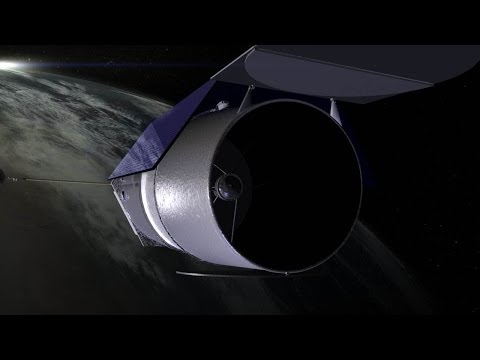
As well as the ice moon missions, the budget proposal includes funding for the 'Wide-Field Infrared Survey Telescope', which will be able to directly image exo planets. Such a prospect is tremendously exciting and would further progress the search for life-bearing planets beyond the solar system, essential if we are to one day colonise planets orbiting other stars.

Wide-Field Infrared Survey Telescope

We need many more missions like this if we are to learn how to survive beyond the confines of Earth. Hopefully this is just the start of a new wave of exploration and research.

Tuesday, 5 May 2015

Millions Living Underground

The only way for our species to avoid extinction is to leave Earth and establish self-sustaining colonies on other worlds. Very few people would disagree with that. But such an endeavour is proving to be almost impossible for the world's governments to get to grips with. The only projects making any progress are private enterprises focusing exclusive on Mars, most notably Mars One. But the funding for such projects to actually achieve their aims is uncertain at best.

The economic and political turmoil in the world is unlikely to diminish for many decades, if not centuries, which will make make governments unlikely to commit to or cooperate on any off-world colonisation efforts. This puts the continuation of human civilisation at considerable risk. The next best thing, and something governments may well consider, would be to create places on Earth where humans could survive global catastrophes. There are some examples of this, mostly created during the cold war. The USA, Soviet Union and China created some quite significant underground shelters. But those would protect just a few thousand people for a few months.

What is needed are facilities around the world that could protect millions of people for decades, or longer.  Such facilities would need to be deep underground, deep enough to survive even a very close and large asteroid strike, and have no reliance on resupply from the surface.

No matter how large and well designed such a facility is, it could never be permanent.  The Earth will still become utterly uninhabitable one day. The humans living there would have to continue researching and planning their eventual evacuation of of the planet. To facilitate this a level of high-technology would need to be maintained. This technology must include the ability for large and regular space launches. Having to live in such an enclosed environment, with the knowledge that the surface is most likely uninhabitable, would focus the minds of scientists and engineers (and probably the entire population, including the government) on the goal of leaving the Earth.

There's an interesting short story on this subject, called 'Under Pindar', about a massive secret cavern deep beneath London. The background to the story can be read here.

The entrance to a suspected lava tube on the moon
The very act of designing and constructing such subsurface habitats would lead to advances in knowledge and skills that would be very useful when we do come to colonise planets and moons in our solar-system and beyond. The ability to build well-protected underground habitats would be preferred to surface habitats on airless worlds such as most moons, and planets with thin atmospheres such as Mars. Utilising natural underground chambers, such as lava tubes, would save excavation time. There is evidence to suggest that such lava tubes do indeed exist on the moon and Mars, and that due to the low gravity they may be very large indeed, some being tens of metres or more in diameter. There is even a likelihood that channels up to a kilometre in diameter may be possible. The potential for spacious habitats in such locations is tremendous.

An interesting study on the potential of lunar lava tubes can be read here.

Perhaps digging should be our first instinct, before we aim outwards?

Sunday, 15 March 2015

Colonies Under the Ice Moons

Deep beneath the surface of many of our Solar System's worlds are hidden oceans. Jupiter's moon Europa is probably the best known, but two of its other moons, Ganymede and Callisto, also have significant subsurface oceans.
Geysers on Saturn's moon, Enceladus

Saturn's moon Enceladus has very recently been shown to have liquid water beneath its icy surface, its active geysers, over a hundred of them, being the most compelling evidence for this.

And even Ceres in the asteroid belt and Pluto are prime suspects for such deep oceans.

An exploration of such oceans is long overdue, and not because there may be signs of life down there. There is a much more important reason than that.  We need to know how viable such locations are for underwater human colonies.  If such colonies could be built they would have the following advantages:
  • the hundreds, and likely thousands, of metres of ice above would provide a huge amount of protection from deadly hazards such as meteor strikes, cosmic radiation, attack and supernovae
  • oxygen and hydrogen could be harvested from the water to breath and for fuel
  • if the oxygen levels are high enough there may be marine life, feeding off the minerals from volcanic vents in the moons' rocky cores, which could provide a food source
  • Earth's deep sea marine life could be introduced to further improve food stocks

A small manned submarine on Europa
Colonies could be built in different ways depending on the conditions found, but they are likely to be habitats attached to the underside of the ice cover or dug deep into the ice. Submarines would be used for transportation between the habitats, and for exploration of the oceans. Large enough submarines could even become permanent habitats themselves.

Access to the colonies would be by a shaft to the surface, with possible habitats located at various levels on the way up (as suggested by the Objective Europa proposal). A small facility would be located at the surface to receive new arrivals and supplies, and for colonists to leave the moon, or embark on surface activity.

With such a large choice of worlds to colonise in this way, once the technology and experience of one attempt is realised it would be relatively easy to colonise the others. The shelter offered by such locations is so good that research and mission planning should commence immediately.

A surface base on an ice moon of Jupiter

Titan - Our Best Subsurface Destination


There is one moon I have yet to mention, and it is probably the best location for such a colony. That moon is Saturn's largest, Titan. Like the large Jovian moons, Titan has a global subsurface ocean, but unlike all the others it also has a thick atmosphere which would offer significant protection for surface bases.

The internal structure of Saturn's moon, Titan

Titan should, in my opinion, be the focus of research for such colonies. But no proposals for manned missions or colonisation exist. The only proposal I can find regarding Titan is a NASA submarine mission to explore the moon's hydrocarbon and methane surface seas.

A submarine exploring one of Titan's seas
If this goes ahead it will indeed be fascinating, but it is unlikely to further the cause of human colonisation beyond Earth. That should be the focus of ALL future space missions.

Sunday, 22 February 2015

Heavy Industry on Mars

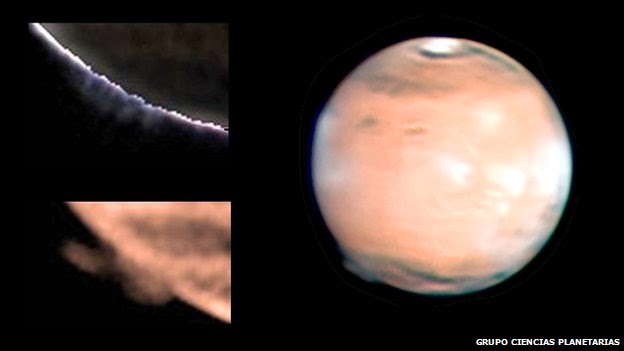
Then enormous clouds recently seen on Mars, rising up to 260 kilometres above the surface, are intriguing evidence of what could be a tremendous increase in visible intelligent activity on that world.

Huge cloud plumes on Mars
First seen in 2012, the huge plumes could very well be the result of intense large-scale industrial activity, perhaps the culmination of decades or even centuries of subterranean activity that now requires a move to the surface.

Observations have shown that the clouds fade during the Martian daytime, and then reappear each morning for at least ten consecutive days. The surface activity is taking place at night, no doubt to minimise the risk of detection by NASA’s or ESA’s orbiting probes. That strategy appears to have been successful, as the only observations of the clouds have been from Earth. Of course, it’s quite possible that the US and European space agencies have plenty of close-up evidence that is too sensational, or too distressing, to be released into the public domain.

So what could the purpose of the activity on Mars be? There are many possibilities, but the following two are most likely in my opinion:

1. Terraforming

The residents of Mars have had to live in subterranean domains for many hundreds of thousands of years since their planet’s ability to support them on the surface was lost. They have finally developed the required planetary engineering technology to transform and thicken the Martian atmosphere back its former liveable state. In 2012 the process was started. It is likely to take centuries to complete.

Mars at different stages of the terraforming process

2. Evacuation

After many millennia living deep under the surface, and after accepting the fact that their once habitable planet is beyond recovery, the remaining population of Mars is evacuating. Launching at night, the evacuation spacecraft are heading to some location in the Solar System, most likely in the asteroid belt or Kuiper belt, where they will either join up and be reconfigured into a large generation ship, or dock with an existing generation ship constructed using the vast resources available in those regions. When the evacuation is complete and the generation ship ready it will embark on its interstellar journey to a new star system.

A Martian generation ship under construction in the asteroid belt

If the first possibility, the terraforming of Mars, is underway then it will be easy to observe, and prove quite fascinating. If the evacuation is happening then that will be much harder to observe. A search should now be started to find the generation ship before it leaves. And when it does leave we need to determine its destination. The Martians may well have discovered a habitable planet around a nearby star, which is something we need to know about.

I am hoping the evacuation is underway.  When it’s completed it will provide us with a vast and deserted subterranean habitat on Mars, perfect for thousands and eventually millions of humans to live in, helping to ensure the survival of our species.

I've no doubt that the teams running the current Martian colonisation attempts, such as Mars One, are also hoping the evacuation scenario plays out.

Thursday, 1 January 2015

Pluto and Orcus - Ideal Observation Outposts

The New Horizons spacecraft will finally reach Pluto this year. With its close encounter just a few months away there is obviously a lot of interest in the dwarf planet, and so there should be. But I'm just as interested in its almost equal, and opposite, 'relation', Orcus.

What is most interesting about the two dwarf planets are their orbits, shown below.

The orbits of Pluto (red), Orcus (blue) and Neptune (white)
The orbit of Orcus is similar to Pluto's but is oriented differently. The mutual resonance of Pluto and Orcus with Neptune ensures that both of the dwarf planets remain in opposite phases of their otherwise very similar orbits.

This seems too much of a coincidence, and unlikely to be entirely natural. I believe at least one of them was deliberately maneuvered into such an orbit.

With the two dwarf planets either on opposite sides of the Solar System, or above and below the elliptical plane, observation posts on both worlds would be able to monitor the whole Solar System. With advanced radio and optical telescopes all of the activities of humans would be visible. They are ideal locations to monitor our progress.

If such an observation post exists on Pluto it’s possible it will be discovered by the New Horizons probe as it passes by. But such a discovery is unlikely, even though NASA scientists will almost certainly spend considerable time looking for evidence of such things. The facility will almost certainly be underground, with its surface instruments camouflaged, or even retracted temporarily as the probe passes by. I'll be examining any unusual or unexpected features on the images returned with great interest.

View from the surface of Pluto, with its moon and the sun visible.
An observation outpost in such a location would be able to covertly monitor
our activity in the inner Solar System.

There is another way to detect the presences of the observation posts.

Pluto and Orcus are always in line of sight with each other, which would allow constant communication between the two. Observation posts on those two bodies are likely to exchange data with each other using highly focused means, such as microwaves or lasers, which would be undetectable except by a probe sent to a position directly between the two. If such a mission went ahead it may well reveal an extra terrestrial presence on the two dwarf planets and provide the first evidence that we are being observed. It’s a thrilling, yet alarming, prospect.

Of course, there could be an intermediary involved.  A third location, well above or below the elliptical plane of the Solar System, where a relay station receives the communications.  This would avoid the need to ever send messages through the centre of the Solar System (which would increase the risk of detection).

If we are to successfully expand our civilisation to the stars we need to know who’s watching us, and why, so that we can start watching them.

Monday, 8 December 2014

Atlas and Pan - Saturn's Generation Ships

With over sixty moons and its complex ring system Saturn is one of the most diverse and intriguing regions of the Solar System. While a lot of scientific interest is directed at the planet's largest moons, such as Titan and Enceladus, the two most interesting to me are two of the smallest: Atlas and Pan.

Atlas and Pan, Saturn's most intriguing 'moons'

Both the moons are shepherd satellites, part of a small group of moons that are said to maintain Saturn's rings' sharp and well-defined edges. But the appearance of these two moons is not at all what you would expect if they had formed naturally. They look extremely unnatural, in fact.

They probably are.

Both moons are likely to be the long abandoned remains of two advanced generation ships. These vast vessels, capable of supporting hundreds of thousands of individuals for tens of thousands of years, were probably in the Saturn system attempting to harvest anti-matter to use as fuel, perhaps for their Alcubierre propulsion system. Such as propulsion system for such large spacecraft would require a significant amount of anti-matter, but obtaining this amount would be feasible at Saturn (or indeed Jupiter). It's estimated that up to a kilo of anti-protons enters the Solar System every second, which will become concentrated in the magnetic fields of the giant planets. Despite this, it does seem that Atlas and Pan were not able to collect enough in time to escape.

Over many millions of years the spacecraft have attracted a lot of dust and debris from Saturn's rings, which is why their appearance is now moon-like, at least in their bulging central sections.

The diagram below shows the possible interior of Atlas (click to enlarge). Pan is no doubt similar:


A mission to those moons is long overdue. A lander is required, one that can drill deep into the crust down to the hull beneath. And later a manned mission to enter one of the giant ships. Only then will we begin to understand why they visited Saturn, and why they had to stay. Perhaps we will find the occupants, some even surviving in deep hibernation awaiting rescue. And we may be able to reverse engineer the technology we find to accelerate our own advancement towards interstellar travel.

It's entirely possible, of course, that the ship, although stranded, is otherwise functioning perfectly normally (the anti-matter it managed to acquire could be more than enough to run the ship's systems for millenia, even though the Alcubierre propulsion system is not able to function). It's occupants could be living out their lives, generation after generation, totally oblivious to their predicament, trapped in the 'planned ignorance' phase of their journey by the ship's controlling intelligence (such a phase would continue to avoid the risk of some occupants developing the desire to escape. Only when the destination system was reached would the current generation receive education on the ship's purpose and their colonisation mission).  Finding such an orbiting colony would be a momentous discovery.

The overriding reason for such a mission is that it may be essential to our immediate survival. If the 'Atlas' and 'Pan' generation ships have indeed collected some anti-matter their storage facility may have degraded and be at risk of failure. Such a failure would set off an anti-matter explosion that could be catastrophic, even here on Earth, and prematurely end our civilisation.

It's a chilling prospect, and one that should not be ignored.