Sunday, 22 February 2015

Heavy Industry on Mars

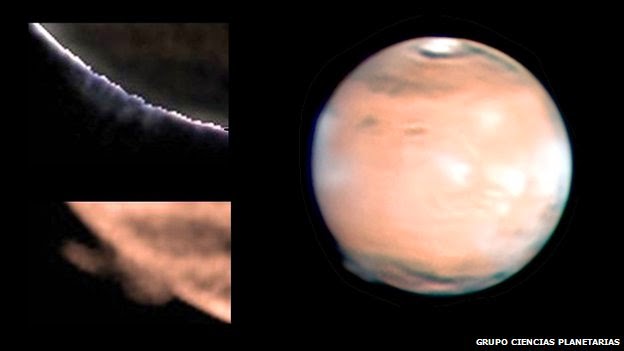
Then enormous clouds recently seen on Mars, rising up to 260 kilometres above the surface, are intriguing evidence of what could be a tremendous increase in visible intelligent activity on that world.

Huge cloud plumes on Mars
First seen in 2012, the huge plumes could very well be the result of intense large-scale industrial activity, perhaps the culmination of decades or even centuries of subterranean activity that now requires a move to the surface.

Observations have shown that the clouds fade during the Martian daytime, and then reappear each morning for at least ten consecutive days. The surface activity is taking place at night, no doubt to minimise the risk of detection by NASA’s or ESA’s orbiting probes. That strategy appears to have been successful, as the only observations of the clouds have been from Earth. Of course, it’s quite possible that the US and European space agencies have plenty of close-up evidence that is too sensational, or too distressing, to be released into the public domain.

So what could the purpose of the activity on Mars be? There are many possibilities, but the following two are most likely in my opinion:

1. Terraforming

The residents of Mars have had to live in subterranean domains for many hundreds of thousands of years since their planet’s ability to support them on the surface was lost. They have finally developed the required planetary engineering technology to transform and thicken the Martian atmosphere back its former liveable state. In 2012 the process was started. It is likely to take centuries to complete.

Mars at different stages of the terraforming process

2. Evacuation

After many millennia living deep under the surface, and after accepting the fact that their once habitable planet is beyond recovery, the remaining population of Mars is evacuating. Launching at night, the evacuation spacecraft are heading to some location in the Solar System, most likely in the asteroid belt or Kuiper belt, where they will either join up and be reconfigured into a large generation ship, or dock with an existing generation ship constructed using the vast resources available in those regions. When the evacuation is complete and the generation ship ready it will embark on its interstellar journey to a new star system.

A Martian generation ship under construction in the asteroid belt

If the first possibility, the terraforming of Mars, is underway then it will be easy to observe, and prove quite fascinating. If the evacuation is happening then that will be much harder to observe. A search should now be started to find the generation ship before it leaves. And when it does leave we need to determine its destination. The Martians may well have discovered a habitable planet around a nearby star, which is something we need to know about.

I am hoping the evacuation is underway.  When it’s completed it will provide us with a vast and deserted subterranean habitat on Mars, perfect for thousands and eventually millions of humans to live in, helping to ensure the survival of our species.

I've no doubt that the teams running the current Martian colonisation attempts, such as Mars One, are also hoping the evacuation scenario plays out.

Thursday, 1 January 2015

Pluto and Orcus - Ideal Observation Outposts

The New Horizons spacecraft will finally reach Pluto this year. With its close encounter just a few months away there is obviously a lot of interest in the dwarf planet, and so there should be. But I'm just as interested in its almost equal, and opposite, 'relation', Orcus.

What is most interesting about the two dwarf planets are their orbits, shown below.

The orbits of Pluto (red), Orcus (blue) and Neptune (white)
The orbit of Orcus is similar to Pluto's but is oriented differently. The mutual resonance of Pluto and Orcus with Neptune ensures that both of the dwarf planets remain in opposite phases of their otherwise very similar orbits.

This seems too much of a coincidence, and unlikely to be entirely natural. I believe at least one of them was deliberately maneuvered into such an orbit.

With the two dwarf planets either on opposite sides of the Solar System, or above and below the elliptical plane, observation posts on both worlds would be able to monitor the whole Solar System. With advanced radio and optical telescopes all of the activities of humans would be visible. They are ideal locations to monitor our progress.

If such an observation post exists on Pluto it’s possible it will be discovered by the New Horizons probe as it passes by. But such a discovery is unlikely, even though NASA scientists will almost certainly spend considerable time looking for evidence of such things. The facility will almost certainly be underground, with its surface instruments camouflaged, or even retracted temporarily as the probe passes by. I'll be examining any unusual or unexpected features on the images returned with great interest.

View from the surface of Pluto, with its moon and the sun visible.
An observation outpost in such a location would be able to covertly monitor
our activity in the inner Solar System.

There is another way to detect the presences of the observation posts.

Pluto and Orcus are always in line of sight with each other, which would allow constant communication between the two. Observation posts on those two bodies are likely to exchange data with each other using highly focused means, such as microwaves or lasers, which would be undetectable except by a probe sent to a position directly between the two. If such a mission went ahead it may well reveal an extra terrestrial presence on the two dwarf planets and provide the first evidence that we are being observed. It’s a thrilling, yet alarming, prospect.

Of course, there could be an intermediary involved.  A third location, well above or below the elliptical plane of the Solar System, where a relay station receives the communications.  This would avoid the need to ever send messages through the centre of the Solar System (which would increase the risk of detection).

If we are to successfully expand our civilisation to the stars we need to know who’s watching us, and why, so that we can start watching them.

Monday, 8 December 2014

Atlas and Pan - Saturn's Generation Ships

With over sixty moons and its complex ring system Saturn is one of the most diverse and intriguing regions of the Solar System. While a lot of scientific interest is directed at the planet's largest moons, such as Titan and Enceladus, the two most interesting to me are two of the smallest: Atlas and Pan.

Atlas and Pan, Saturn's most intriguing 'moons'

Both the moons are shepherd satellites, part of a small group of moons that are said to maintain Saturn's rings' sharp and well-defined edges. But the appearance of these two moons is not at all what you would expect if they had formed naturally. They look extremely unnatural, in fact.

They probably are.

Both moons are likely to be the long abandoned remains of two advanced generation ships. These vast vessels, capable of supporting hundreds of thousands of individuals for tens of thousands of years, were probably in the Saturn system attempting to harvest anti-matter to use as fuel, perhaps for their Alcubierre propulsion system. Such as propulsion system for such large spacecraft would require a significant amount of anti-matter, but obtaining this amount would be feasible at Saturn (or indeed Jupiter). It's estimated that up to a kilo of anti-protons enters the Solar System every second, which will become concentrated in the magnetic fields of the giant planets. Despite this, it does seem that Atlas and Pan were not able to collect enough in time to escape.

Over many millions of years the spacecraft have attracted a lot of dust and debris from Saturn's rings, which is why their appearance is now moon-like, at least in their bulging central sections.

The diagram below shows the possible interior of Atlas (click to enlarge). Pan is no doubt similar:


A mission to those moons is long overdue. A lander is required, one that can drill deep into the crust down to the hull beneath. And later a manned mission to enter one of the giant ships. Only then will we begin to understand why they visited Saturn, and why they had to stay. Perhaps we will find the occupants, some even surviving in deep hibernation awaiting rescue. And we may be able to reverse engineer the technology we find to accelerate our own advancement towards interstellar travel.

It's entirely possible, of course, that the ship, although stranded, is otherwise functioning perfectly normally (the anti-matter it managed to acquire could be more than enough to run the ship's systems for millenia, even though the Alcubierre propulsion system is not able to function). It's occupants could be living out their lives, generation after generation, totally oblivious to their predicament, trapped in the 'planned ignorance' phase of their journey by the ship's controlling intelligence (such a phase would continue to avoid the risk of some occupants developing the desire to escape. Only when the destination system was reached would the current generation receive education on the ship's purpose and their colonisation mission).  Finding such an orbiting colony would be a momentous discovery.

The overriding reason for such a mission is that it may be essential to our immediate survival. If the 'Atlas' and 'Pan' generation ships have indeed collected some anti-matter their storage facility may have degraded and be at risk of failure. Such a failure would set off an anti-matter explosion that could be catastrophic, even here on Earth, and prematurely end our civilisation.

It's a chilling prospect, and one that should not be ignored.


Tuesday, 11 November 2014

The Cloud Tops of Venus

Venus
Of all the solid worlds in the Solar System, Venus has to be the worst place to settle a surface colony. The average surface temperature is 462 degrees Celsius, the air pressure is 90 times that of Earth, and the atmosphere consists almost solely of carbon dioxide. The sulfuric acids clouds only add to the already hellish conditions. Even the most hardened landers sent there so far, the Russian Venera probes, lasted only a few hours before being destroyed. It seems that a surface colony is out of the question for humans.

But what about high up in the atmosphere?

At an altitude of around 53 kilometres, right at the cloud tops, the air pressure and temperature is much like that at Earth's surface. The air is not breathable, and there would still be the sulfuric acid clouds to deal with at times, but it is more than possible to construct suitable floating habitats for that region with our current technology. And because air we breath is much lighter than the atmosphere of Venus it makes an ideal lifting gas, much like helium does in our atmosphere. Some type of airship would be ideal as humans could live directly inside the aircraft's 'balloon'. It would make for a very spacious habitat. Something similar was proposed by Russia back in the 1970s, so this sort of thing has been discussed for decades.  

Russian idea for floating Venus colonies
It is plausible, affordable, and something that would be essential to diversify our habitats, and the lessons learnt would be invaluable when making colonisation attempts high in other atmospheres, such as those of gas giants.

A recent NASA proposal for airship colonies on Venus

Despite the extreme conditions on Venus, there is possibly some evidence that life of some sort may be down there. A Russian researcher has suggested that the Venera 13 lander photographed lifeforms that were disturbed by the lander's touchdown. Further lander missions should be sent to investigate his claims, and it seems such a mission could happen in the 2020s. I've recently discovered that Russia is planning to send a rover to Venus during that decade. I will be watching with great interest.

Tuesday, 6 July 2010

Colonisation of the Oort Cloud

I've been thinking a lot about the resources of the outer solar-system recently.

There are millions of objects out there large enough to house tens of thousands of inhabitants, and all of them are abundant in water ice and other essentials such as ammonia, carbon-rich compounds and significant amounts of deuterium and helium-3.

Colonists could live in hollowed-out Kuiper Belt and Oort Cloud planetoids and comets. Those objects could have their rotations modified to generate a simulated gravity close to that on Earth, and they could even be converted into slow interstellar ships (generation ships).


All of this potential is something that seems to be almost completely ignored by governments and space agencies. That is a grave mistake.

Callisto would be the ideal 'stepping-stone' to such habitats. It is far enough away from its parent planet, Jupiter, to avoid its fierce radiation belt, and it does not suffer the damaging tidal effects of the other large inner moons such as Europa and Ganymede. Here's an illustration of a base on that moon:


A large human colony could be created there within a century or two. The abundance of water would make it the ideal place to manufacture fuel for the transports that would take colonists out to the trans-Neptunian objects.

It is quite astonishing that a space programme is not already in place to colonise Callisto. The benefits to the continuity of the human species are obvious and enormous.

Of course, there is the risk that the Oort Cloud is already colonised. Like the Kuiper Belt, the Oort Cloud is the ideal place for extra-terrestrial intelligences to monitor our activities in secret. The only way to find out is to go there. The only mission heading that way is NASA's New Horizons - and that's only going to a couple of Kuiper Belt objects. Dozens more missions are necessary. especially to the Oort Cloud. It should be given the highest priority as the colonisation of such objects is a higher priority than the colonisation of the Moon and Mars.

We need to begin a slow and steady exodus from the Earth, and the resource-rich objects at the edge of the solar system are the first best options for the construction of the colonies and star ships required to ensure the survival of our species and to take us on our first journey to the stars beyond.

Thursday, 17 June 2010

The Kuiper Belt


The Kuiper Belt region of the solar-system, stretching way beyond the orbit of Neptune, is a dark and resource-rich region of space. It is the perfect place from which to monitor the inner solar-system.

Since its discovery in 1992 thousands of objects have been discovered out there, and not all of them can be explained simply as huge lumps of ice. KBO 55636 is one of those. It was originally thought to be quite a large object with a dull surface (due to its incredible age and the bombardment with dust and cosmic rays), but recent measurements suggest that it is a small (300 kilometres in diameter) and highly reflective.

Such an object should not be there, unless it was placed there deliberately.

The Kuiper Belt is an ideal location for a large monitoring station, one that provides backup to smaller clandestine stations in the asteroid belt. The purpose of such stations would, of course, be to monitor our activities here on Earth. And the distant Kuiper Belt station would also be a more comfortable place to live for the beings working at the monitoring stations. It is likely that such a station would provide powerful signal relay abilities.

NASA's New Horizons mission will visit the Kuiper Belt's most famous object, Pluto, in 2015. It will then go on to explore further objects in that region. Such a mission will allow us to gain more information about that mysterious and potentially sinister region of our solar-system.

Evidence of advanced intelligence is likely to be found in the darkest and coldest of places. The Kuiper Belt is one of those places. The information sent back by New Horizons will be very interesting indeed.

For an spectacular novel featuring a large Kuiper Belt-style planetoid read The Kretins of Doctor Combobulay free online, or download the PDF here.

There is even a song about such an object, and a sinister one at that. It's by Dayglo Fishermen and is called Nerdlinger One. It's free to download.

Tuesday, 18 May 2010

The Residents of Phobos

I find Phobos, the larger of the two moons of Mars, one of the most intriguing natural satellites in the Solar-System. And so do the world’s space agencies, it seems.

At only around 22 kilometres in diameter it is very small as moons go, and its lack of an atmosphere makes it appear relatively uninteresting when compared to the large moons of the outer planets, such as Titan, Europa and Triton.

It is far from uninteresting.

The European Mars Express probe has recently made some close approaches to Phobos. As well as returning yet more stunning photos of the moon, the probe confirmed something that was first speculated in the 1950s – Phobos is not solid. It contains ‘voids’ beneath its surface, and some of them are very large. The potential uses for such concealed natural spaces are numerous, the most obvious being as research and surveillance facilities, and hanger bays.

I believe the voids have been in use, but they have now been abandoned.

Until very recently there was a very high failure rate for space probes bound for Mars and its moons, far higher than you would expect for such an apparently benign environment. Russia once attempted a landing on Phobos. The attempt failed. All missions to Phobos so far have failed.

In a year or two Russia will send its Phobos-Grunt lander down to the surface of Phobos to analyse the rocks and return samples to Earth. If that succeeds then we can be sure that the alien ‘presence’ that had been utilising the moon’s natural sub-surface facilities will have left. The only way we will find out more about them is to dig into the moon and explore the maze of caverns far below its surface. Such a mission should be given the highest of priorities as some evidence of the former residents of Phobos is highly likely to exist down there.

But I wonder: if they have indeed left, where did they go? And why were they there?

There seems to have been a huge resurgence of interest in the red planet and its moons over the last decade, and there is far more known or suspected about Phobos than the authorities admit. There has been no adequate explanation of the grooves on its surface, nor of the 'monolith'.

It is a most interesting place.