Showing posts with label alien technology. Show all posts

Monday, 1 July 2019

Tiny Moons - The Perfect Hiding Places

The Solar-System's smallest moons, many of which are only just being discovered, may hold vital clues as to the nature of the activities of extra-terrestrial civilisations in our region of the galaxy.

I've mentioned before the possibility that there are abandoned extra-terrestrial facilities in the Solar-System. In 2014 in my article 'Atlas and Pan - Saturn's Generation Ships' (and in a recent follow-up 'Saturn's Unnatural History') I discussed the prospect that Saturn's unusual moons, Atlas, Pan, and Daphnis, could well be huge star ships that arrived in our star system millions of years ago.

Saturn and its moons seems to have been a system of great interest to extra-terrestrial visitors many millions of years ago.

Atlas, Daphnis and Pan: Saturn's unusual moons that may well be abandoned star ships. The amount of dust covering their surfaces suggests that they were abandoned many millions of years ago.

This has had me thinking more and more about the smallest moons in the Solar-System. They are very hard to find, even when a space probe is in orbit around the host planet for many years. Very recently 12 new moons were discovered orbiting Jupiter. They are all very small, the largest no more than five kilometres across, and many are in a retrograde orbit. It's surprising that the Galileo spacecraft, which was in Jovian system for 8 years from 1995 to 2003, did not see those moons at all, but it's not surprising that they exist. Some of them may well have been placed there intentionally. Such moons would be ideal locations for clandestine colonies to hide, and for passive surveillance equipment to be placed to monitor our civilisation's development.

Calypso, one of the trojan moons that shares the orbit of Tethys, one of Saturn's moons. Calypso is just under 11 kilometres in length. It would make an ideal observational outpost.

Four of Jupiter's other small moons that are also of interest are Telesto and Calypso (above), which are trojan bodies in the same orbit as that of the large moon Tethys, and Helene (below) and Polydeuces, both trojan bodies of the large moon Dione. It would be very easy for an advanced civilisation to conceal passive monitoring technology on such moons, and keep it hidden even after a technologically capable civilisation such as ours had made very close observations.

Helene, one of Dione's trojan companion moons

Another example is Neptune's 14th moon, which was discovered in 2013 and recently named Hippocamp. It was found hidden in some of the Hubble Space Telescope's old data. At just under 35 kilometres in diameter, and dark in colour, it's no surprise that it was missed when Voyager 2 passed through Neptune's system in 1989. This small moon is another ideal example of an object large enough to sustain a colony, but small enough to be largely ignored.

An artist's impression of Hippocamp, the recently discovered moon of Neptune. At just under 35 kilometres in diameter it would be large enough to sustain a colony, or host a wealth of clandestine observational equipment, but it is small enough to go unnoticed, and to be largely ignored when eventually found.

To understand why extra-terrestrial explorers would make use of such small moons, we only need to consider why we would use such moons in a similar situation. If humans found a star system with a life-bearing planet and we were able to visit that system we would want to learn as much about that life as possible. How advanced that life is would determine how we would monitor it without affecting its development.

If the life was primitive and consisted of nothing more than simple plant and animal life, such as during Earth's Ordovician period almost half a billion years ago, then probes in close orbit of the planet, and even airborne craft in its atmosphere, could be used. Surface missions could also be permitted (under very strictly adhered to planetary protection protocols) to gather samples. A permanent surface base would be possible.

If intelligent life was detected, but it was still in the early stages of building a civilisation such as bronze age societies, then close orbital probes would still be possible. Missions to the ground would be unwise anywhere but the most remote and underpopulated areas, but high altitude airborne flights could be done over populated areas. Such early civilisation would have little understanding of things beyond their immediate environment, but they would be curious, so great care would have to be taken not to be noticed.

Monitoring the development of a civilisation capable of producing art such as this from the bronze age in China more than 5,000 years ago would need to be done very carefully to avoid influencing their development

If there was a more advanced civilisation at the level of a pre-industrial society where it is likely that scientific research into what lies beyond the atmosphere is being done, close orbital probes should be avoided as they could be seen. Monitoring should be done from high geostationary orbit. Research bases on the planet's moon(s) or nearby bodies should be used.

If there is a technologically advanced civilisation that is able to launch space missions, then it should be monitored well away from the planet. The small moons around that system's other planets would be ideal, as they will remain undetected for much longer, and are unlikely to come under close scrutiny even when discovered.

We are such a civilisation.

It's quite possible that we have been under surveillance by an extra-terrestrial civilisation for quite some time. And now, as we are sending spacecraft out to explore the Solar-System, that surveillance has retreated to distant small moons where we are unlikely to pay much attention. For that reason we should be paying extra attention to those moons. Many 'small moons' missions should be launched. And perhaps we should also launch probes to the outer Solar-System to an orbit beyond Neptune, where we can detect the possible transmissions that are being sent back to the home system of those that are monitoring us. Some of those probes should also orbit the sun well out of the normal planetary plane to ensure full coverage.

If we do all that we should have a good chance of discovering evidence that we are being watched.

And if we do make such a discovery, those watching will know about it. They may well decide that it's time to make direct contact.

Wednesday, 1 May 2019

Alien Technology Could Seal Our Fate

It's possible that the technology of an advanced extra-terrestrial civilisation is in the possession of some governments. If so, reverse engineering efforts will certainly be in progress, and the fruits of such efforts are likely to have already been incorporated into various, and still secret, machines and devices.

While the initial use of such technology will almost certainly be for military purposes, it will ultimately benefit our species as a whole. We could be on the verge of a surge in development of advanced and super-efficient energy generation and space propulsion. If alien technology is secretly being studied then it couldn't be more timely. Understanding and utilising it could literally rescue the human race and our planet from the devastating effects of climate change. It may even prevent our extinction.

Small and incredibly efficient nuclear fusion technology could soon provide all of us with clean and almost unlimited power, thanks to the reverse engineering of extra-terrestrial technology that's centuries ahead of our own

The 21st century will be a make or break period for us. We'll either start on our path to interstellar colonisation, or condemn ourselves to oblivion. Those are the two very clear paths that our species can take. Even without the advantage of advanced alien technology those paths are open to us (such technology would simply help us to take either path much sooner). We can either resolve our destructive differences and work together to heal and protect our planet, and take our human civilisation to the stars, or we can remain conflicted, arrogant and selfish, and continue on our ever accelerating plunge to extinction.

Unfortunately, any government that has access to advanced alien technology will keep it a secret for as long as possible, and any benefits gained from its use will be closely guarded. The reasons are understandable when you consider human nature. If the technology were made public its use for criminal or military action would be swift. No nation possessing it would want to put itself at risk of such action. Because of this the reasons for any government keeping the technology secret would be justified. And so would its reasons for developing military uses for the technology first.

The governments that have access to alien technology will almost certainly use it to gain a military advantage. That's understandable, when the world's political and economic problems are considered, but it could actually accelerate our civilisation's fall.

The depressing conclusion we can draw from that fact is that, even with such technology, we would still go down the route of self destruction. Innate selfishness, fear and even paranoia would ensure that. Human nature and our primary survival instinct may well be too powerful to suppress. Such an instinct becomes ironically suicidal when weapons of mass destruction are available (I also cover this point briefly in my 'Machines Meeting Machines' article earlier this year). This supports one of the popular theories as to why there are no detectable technological civilisations in our galaxy (the Fermi Paradox). Any such civilisations have destroyed themselves: all of them. Their once useful survival instincts sealed their doom.

There is the possibility that a more socially conscious government will obtain the technology. If so then it may well use it to develop the means to save our species. That chance is still available.

But, the countries that are most likely to have alien technology are the ones perhaps least likely to use it for the good of us all. Those countries are, of course, the USA and Russia. Those countries, especially Russia, have large amounts of underpopulated land and are best equipped to carry out such research. They have the resources to be able to do the work, and the means to keep the work secret.

The USA's most famous 'secret' area for supposed reverse engineering is Area 51 in the Nevada desert, and it's been the focus of attention for many decades. It is almost certainly involved in secret military development, but any research involving alien technology will have ceased there decades ago. The scrutiny is just too intense. The US government is no doubt happy to keep feeding those interested in the area just enough to keep them distracted from wherever the real research is going on, perhaps in the mountains of Alaska.

A remote and inhospitable valley in Alaska. Such locations would be ideal for a government to hide underground facilities for the reverse-engineering of alien technology.

Russia, too, is likely to doing its development in deep mountain areas, and in the wilderness of Siberia. Those inhospitable areas, with very insignificant local populations are ideal, if harsh, locations that are not easily accessible. And in the much more authoritarian states of Russia it would be easier keep things under wraps, and to keep those with knowledge of what's going on silent.

Whoever possesses alien technology, human nature combined with the current political and economic situation of the world will ensure that it is kept secret and used only for clandestine purposes. It is quite possible that there are even secret human colonies working away from Earth, on the far side of the Moon, and even on other bodies in the Solar-System. In a way that would be quite comforting: it would demonstrate that we have the ability to survive for long periods away from the Earth. But the secret nature of such activities means that it is all in the aid of military and intelligence operations: the result of paranoia and the fear of other humans, rather than the enlightened reason of the continuation of our species.

Humans really need to start working with each other, instead of against each other. We need to sort ourselves out, and fast. We are on the highway to oblivion, but there is still an exit we can take just up ahead. It leads to a road that may well be endless.

Tuesday, 1 January 2019

Machines Meeting Machines

Most science fiction stories that feature alien encounters or visitations show biological creatures that have traveled vast distances. The more I think about it, and the more I read about it, the more I am convinced that this is unlikely to be the way we will eventually meet an extra-terrestrial intelligence.

Our first encounter with such an intelligence will almost certainly be with a machine.

Most people expect that the first encounter with an extra-terrestrial intelligence will be with a biological being, but this is highly unlikely

But why will that be?

Interstellar travel by biological creatures such as ourselves is difficult, costly, and fraught with danger. The food, water and air that's needed for such a journey has to be provided by the star-ship itself. This requires an incredibly complex and almost perfectly tuned biosphere which will need to function for at least a few centuries, and probably far longer. And the ship will need to be huge if it's to accommodate a large enough population to maintain genetic health and diversity.

Building such a star-ship is not impossible. The technical challenges are in no way insurmountable. But the political, emotional, and even ethical obstacles probably are. The world's governments would have to come together and cooperate to get such a project even started. All the military and economic conflicts would need to be resolved, and all the hate and suspicion of our cultural and religious differences transmuted into something positive, respectful and cooperative. And, of course, the general population (whose taxes would fund the venture) would need a lot of convincing as they and their descendants would not see any personal benefit from it.

It does not take much thought to realise that such cooperation goes against the most basic but intensely powerful instinct of any biological life-form: that of self-preservation. Such an instinct is generally beneficial,  but for an advanced civilisation such as ours it could, on a national scale, easily result in an endless series of territorial and ideological conflicts that consume our time and energy. One day the result of such squabbling is likely to result in another global war that could wipe out our species. It's ironic that the survival instinct that has served us well throughout our primitive history, allowing us to evolve into a creature of such high intelligence, could well end up destroying us completely.

Large interstellar spacecraft capable of supporting humans for generations are unlikely to be built until our territorial, political and religious differences on Earth are resolved

That survival instinct is not going to change. Cooperation between governments is not going to reach anywhere near the levels required to build human-crewed star-ships. But the development of crewless interstellar spacecraft requires no such cooperation. And neither does the development of the advanced artificial intelligence to run it. Individual nations, and even individual corporations, can certainly do that.

Because of this our interstellar exploration will almost certainly be conducted by machines. And those machines will contain within them a sophisticated artificial intelligence; one that is able to function autonomously for centuries. And it will be designed to be our ambassador should an advanced alien civilisation be encountered .

Our first encounter with extra-terrestrial intelligence will be with something artificial , rather than a biological life-form. 

And that will be the same for all intelligent extra-terrestrial civilisations. Highly intelligent machines will do the exploration. And due to the communication problems across the vast distances between star-systems those machines will be designed to deal with first contact situations. They will also be able to utilise the resources in the star-systems they visit, replacing and repairing themselves, and even improving their own design. My earlier article, 'Intelligent Machines Are Watching Earth', discusses the possibility that such machines are observing our planet right now.

Its not hard to imagine them setting up machine colonies and constructing more of their kind that will head off in new directions, greatly speeding up their exploration. New machine civilisations will be created. Entire planets could be engineered to be the new home worlds for such artificial creatures.

The home planet for an intelligent artificial species. Over millennia the entire planet has been engineered to accomodate such a species. It will be a highly efficient and sustainable machine civilisation.

It does seem to me that due to the relative ease of manufacturing and distributing intelligent machines across interstellar space, the most abundant form of intelligent life in the universe (if it can be called life) is artificial.

There will, of course, be some biological beings exploring interstellar space, probably on 'world ships': huge vessels, tens or even hundreds of kilometres in length. But they will be exceptionally rare. Due to basic and irrepressible instincts, almost all advanced biological civilisations will render themselves extinct within a few centuries of developing high technology. But many will have survived long enough to initiate interstellar exploration using intelligent machines. Some of those machines - those that are designed to manufacture copies of themselves and make improvements - will go on to establish themselves in other star-systems. Eons after the biological civilisations that first created them have died out, the machine civilisations will continue to thrive and explore.

One day one of our machines will meet one of those machines.

I hope our biological civilisation is still around to appreciate that moment.


Thursday, 1 March 2018

Comfortable Homes on Mars

Mars is one of the most likely places in the Solar-System where the first permanent human colony away from Earth will be established. With the right equipment the planet has all the resources required to sustain a community indefinitely. And there is also the intriguing possibility of discovering evidence of an ancient technological civilisation that once existed on the planet.

Before the search for such evidence can begin there are practical issues that need to be addressed. Habitats with enough space and comfort are required to maintain the physical and mental health of the colonists. And such space and comfort should be ready and waiting even for the very first colonists to arrive. They will need decent quality homes, with enough comforts to get them through the months and years before they have the opportunity to return to Earth. Those habitats should be nothing less than a home from home.

There are plenty of designs for such habitats, but NASA's ice home concept is one of the more practical and impressive ones.

NASA's Mars ice home. The inside is inflated and then the outer shell filled with water. It can be constructed robotically and be ready when astronauts arrive.

The home consists of an inflatable torus within which there are two levels of living space comparable to that of a small house on Earth. The torus is surrounded by chambers filled with ice to provide insulation and radiation protection. The water for the ice will be extracted from the subsurface ice that is abundant in many locations on Mars. Because of this the actual structure itself is very lightweight and can be deployed and build robotically. The homes would be delivered to Mars and prepared over the span of a year or so. When humans finally arrive they'll be able to move immediately into comfortable habitats.

A cross-section of NASA's ice home showing the interior space

Whatever the design of the house, its interior should offer the ocupants the comforts of a home on Earth. It should be a familiar and safe place to return to, with space to relax and have privacy when required.

The first humans visiting Mars will almost certainly face a stay of at least a couple of months, and possibly a year or two.  And that would be after many months of arduous travel in a cramped spacecraft. It is vital that those humans are provided with all the normal comforts possible to allow them to recover physically and mentally: essential for them to do their work effectively, and also for them to prepare for their return journey.


The interior of a house on Mars should offer all the comforts of a home on Earth. It should be spacious, clean, bright, and be familiar and cosy.

Such homes should last many years, and be ideal for the early missions. But ultimately they would be temporary. One day people will arrive on Mars who will never leave. And soon after that the first children will be born there. By that time a substantial and permanent habitat will need to have been constructed.


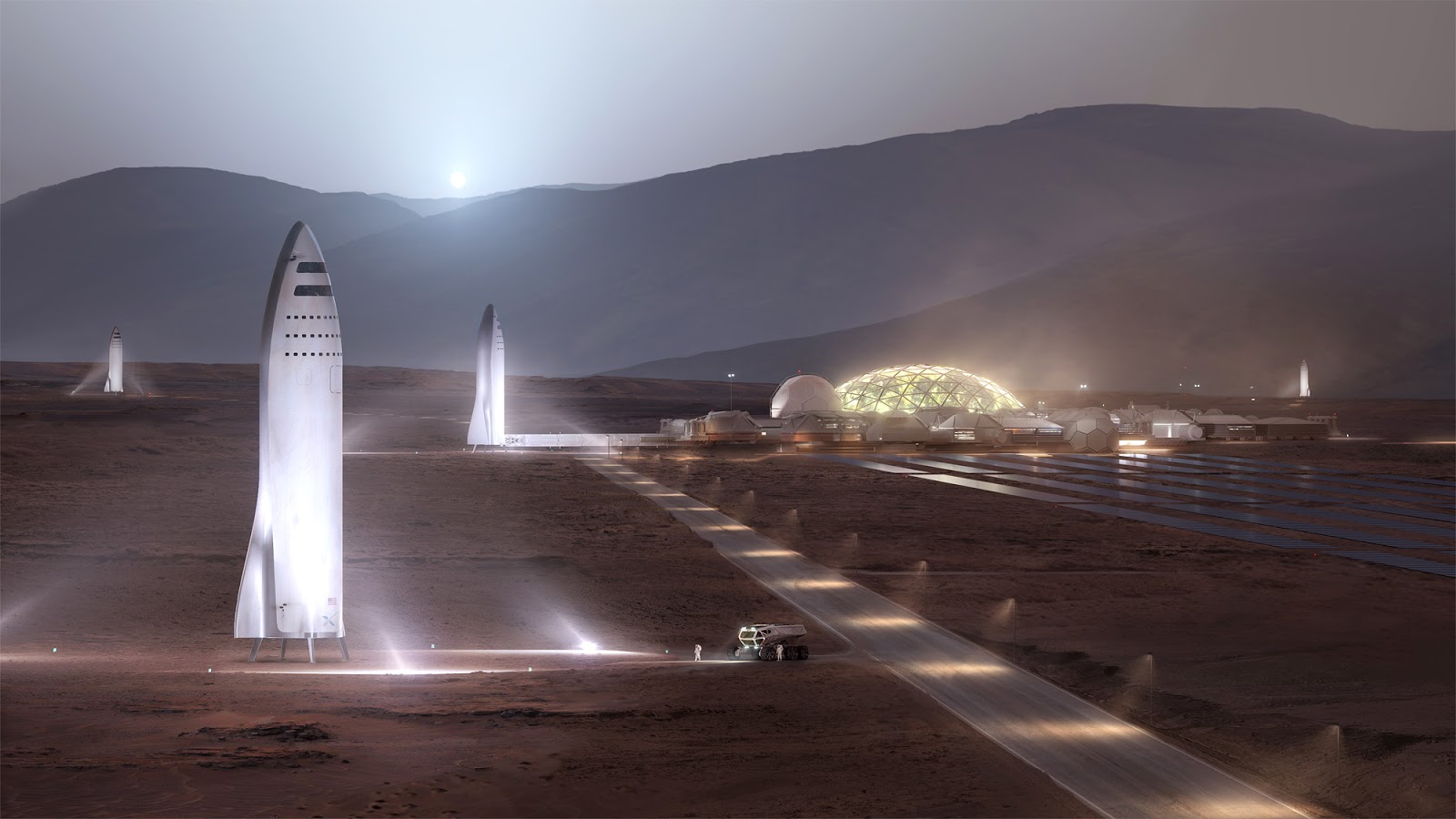
Space X Mars surface colony circa 2050 with a busy spaceport. Large numbers of human are arriving as the construction of permanent habitats continues. Many of those arriving at this time will never leave, and many will start families there.

The best place for permanent homes is below ground, or inside hills and mountains. Excavating such facilities from scratch would be an immense undertaking, but utilising existing underground chambers, such as lava tubes, would reduce the workload significantly. Homes for thousands could be build in such tubes, and the thick shielding required by surface habitats would not be necessary as the roof of the tube would be more than adequate.

A colony set up in the relative safety of a lava tube on Mars

As well as exploiting natural underground voids such as lava tubes, there is the possibility to exploit unnatural voids, too (see my previous articles 'Sanctuary Entrance Found on Mars' and 'Where Did All the Martians Go?'). The search for such 'unnatural' voids is, in my opinion, one of the two primary reasons for sending humans to Mars (the other being, of course, to aid in the survival of our species if and when a global catastrophe occurs on Earth).

There is strong evidence to suggest that Mars was once a temperate world: one that could have been a perfect environment for life to thrive. That environment was likely to have existed for more than a billion years. That's more than enough time for an advanced civilisation to develop. For whatever reason that life-nourishing environment began to fail. It could not be saved. If there was a Martian civilisation it would have had no choice but to retreat underground (with a privileged few managing leaving the planet). 

Eventually the underground civilisation would have died out.

Colonists on Mars explore the remains of a long dead underground Martian city

Many of the vast chambers and warrens of tunnels they constructed must still remain, ready to be exploited when our civilisation arrives on the planet. There may be huge networks of structures and dwellings that could be modified for human habitation. Within just two centuries there could be a population of millions of humans living on Mars with complete independence from Earth.

When the first humans arrive on Mars and have their first colony up and running they must begin the search for those underground chambers. And from where better to embark on that search each day than a safe, spacious and pleasant home with all the familiar comforts of Earth.


Saturday, 1 April 2017

Saturn's Unnatural History


Saturn and it magnificent system of rings and moons is one of the most fascinating regions of the Solar-System. And it's fascinating not only because of its natural history, but because of its likely unnatural history, too.

In a previous article I wrote about the strong possibility that Saturn's two small and unusual moons, Atlas and Pan, could well be abandoned interstellar starships.

The most recent images of Pan, one of Saturn's unusual, and possibly artificial, moons

But there are two other objects in the ringed planet's system that are of extreme interest: the large Moon, Iapetus, and the tiny moon, Daphnis.

Iapetus

Iapetus is the third largest moon of Saturn.  There is much about the moon that is intriguing, but the most intriguing to me is the massive equatorial ridge that runs almost completely around its circumference. At around 20 kilometres wide and 13 high it is a truly monumental feature, especially for a moon only 1,492 kilometres in diameter.

Iapetus - the third largest moon of Saturn

Why is such a feature present, and how can it be exactly on the moon's equator?

The only plausible natural explanation given so far is that Iapetus once had its own ring system similar to its parent world. The rings, formed from the debris of a colliding smaller object, or from the breakup of Iapetus's own moon, rained down onto Iapetus's equator, eventually forming the ridge.

That is an interesting theory, but it does not explain why the ridge is not evenly distributed across the entire equator. Almost a quarter of the equator does not have the ridge. Falling ring debris would have been distributed over a long period of time, and very evenly.

The ridge (centre) that runs three quarters of the entire length of Iapetus' equator

The most likely unnatural possibility is that the ridge is actually a collapsed orbital ring. Tethered to the moon, such a structure would provide easy access to and from the surface, and would be quite an obvious facility for an advanced space-faring civilisation to construct.

An orbital ring, such as this one seen here around Earth, could have collapsed onto Iapetus creating the ridge

Abandoned for thousands of milennia, the structure would eventually decay and collapse, crashing to the surface along the equator of Iapetus. Once the collapse had begun it would progress rapidly, which would explain the unevenness of the ridge, both in its height and its distribution. A gap in the ridge, which we can clearly see, would be highly likely in this scenario.

If this happened it must have been a billion or more years ago as subsequent comet impacts have covered the remains of the ring in ice and debris hundreds of metres thick.

If evidence of a collapsed orbital ring is found beneath the ridge's ice it would provide strong support for the other potential evidence of ancient extra-terrestrial activity in Saturn's vicinity.

A mission to Iapetus is required, which must include an orbiter with ground-penetrating radar to map the remains of the orbital ring, and whatever else may be hidden beneath the equatorial ridge. And if the presence of the orbital ring is confirmed, a manned mission should be launched as soon as possible with the aim of setting up a long term colony on the ridge. Despite the long period of time that has passed since the ring collapsed there would still be plenty of artifacts present that could teach us a lot about the advanced culture that once thrived in the Saturnian system. And there may be clues as to the reason for their demise or departure.

A large human colony on the ridge, established after the collapsed orbital ring theory was proven correct.


Daphnis

Daphnis is one of Saturn's small inner moons with a diameter of just 8.6 kilometres. It orbits within a gap in Saturn's A ring, known as the Keeler gap. In fact, the main reason the gap remains clear of debris is largely because of this moon.

The best current image of Daphnis taken by NASA's Cassini orbiter

One thing Daphnis has in common with the other moons of interest, Atlas, Pan and Iapetus, is that it has an equatorial ridge. This ridge could well be the result of particles falling to the surface from the surrounding ring debris, but the fact that it is on the equator once again makes this highly unlikely. It is more likely to be dust gathering on the shape of the moon's structure, as in the case of Atlas and Pan. And just like Atlas and Pan, the shape of Daphnis suggests it is unnatural in origin.

Saturn's moon, Daphnis, nestled in the Keeler gap within the planet's A ring

The apparent abandonment of so much technology in Saturn's system suggests that the civilisation that developed it had to make a rapid exit (or suffered a catastrophic disaster). They did, however, have the time to place at least three of their vast spacecraft within or very near to Saturn's huge ring structure. Such a move would conceal them from discovery from anything observing from afar. The build up of dust and debris on their hulls has disguised their presence even further.

Daphnis deserves significant study.

The incredible Cassini mission will come to a spectacular finale towards the end of 2017. A new and even more ambitious mission to Saturn is now required. As I mentioned before it must include an Iapetus orbiter with radar capable of mapping objects beneath the icy surface, but it must also include rover missions with deep drilling capability.  There must also be probes to explore the moons within the ring system, with Atlas, Pan and Daphnis the priority. We need to know whether or not a manned archaeological expedition is required to study and exploit the ancient technology that may be present.

The exploration of any signs of extra-terrestrial technology within our Solar-System should be one of the top priorities of Earth's space agencies. Such exploration could result in the knowledge we require to preserve our species beyond the Earth's demise.

When you think about that, any concerns about the cost of such an undertaking pale into insignificance.


Wednesday, 1 March 2017

Subterranean Life on Planet Nine's Moons

The hypothetical planet nine is talked about a lot at the moment. And so it should be. A new and massive planet, currently lurking in the darkness at the far reaches of our Solar-System, is an intoxicating prospect. And it is likely to be confirmed as a reality over the next couple of years as more and more astronomers turn their telescopes to the area of space where it's most likely to be.

Planet Nine

Until it's found and observed closely its origin is unlikely to be known. But there is a strong possibility that it is a captured rogue planet. If it does turn out to be of interstellar origin then that would be very exciting indeed, for it could have brought with it a tantalising glimpse into the possibilities of life and even civilisations that formed hundreds or even thousands of light-years away.

The planet is expected to be a smaller version of Uranus or Neptune with a thick and deep atmosphere of mainly hydrogen. With a mass ten times that of Earth it would be just less that four times the diameter of our world. If so, there is little chance of life on its surface.

It could well be a different story on its moons.

One of Planet Nine's ice moons

Such moons, preserved over the aeons by the deep cold of interstellar space, could well be a treasure trove of artifacts from hundreds of millions of years ago that point to the existence of intelligent life that evolved in a star system far from ours, and when the moon's parent world was in a stable position around its home star. If the civilisation was relatively primitive (no more advanced than ours) it would have ended when some catastrophic event, such as a close encounter with a passing star, dragged the parent world out of its home star system and banished it to the interstellar void.

But if, during such an event, a technologically advanced civilisation existed on one of those moons, it would surely have gone to great lengths to preserve its existence as long as possible. We may well find evidence of deep habitats, seed banks, and even knowledge banks or cultural archives.

The frozen surface of one of Panet Nine's moons. Could the artifacts of an extra-terrestrial civilisation from hundreds of light-years away be hidden beneath the surface?

But what if some remnant of that civilisation still survives, somehow utilising the decaying heat of the moon or parent planet's interior for energy? Rogue planets are not necessarily the lifeless worlds we usually imagine (see my earlier article on rogue planets).

Another intriguing idea is that a civilisation, aware of its decline towards extinction on its home world, colonised Planet Nine as it passed close by. Using the rogue planet as natural interstellar generation ship, the colonists would have planned for a voyage of hundreds of millions of years with an indeterminable destination. They would have also had to prepare for the possibility that no suitable star system would ever be reached.

To ensure survival such preparations would have to include a meticulously designed ecosystem, safely contained from the harsh interstellar void. This would most likely be beneath the ice of a moon with access to the ocean beneath. Such an ocean, seeded with life from the civilisation's home world, would be the most likely source of food, water and oxygen for the colony. And it could be a source that could indeed, with disciplined management, provide for a journey and time span of such magnitude.

There is great risk in embarking on such a journey. After tens of thousands of generations the colonists may well lose sight of their ultimate aim. Such a subterranean existence would change a civilisation from an outward looking and curious culture to a simpler and inward looking one focused more and more on nothing but its day to day existence. Devolution could occur, with physical and mental abilities simplifying over the generations to match the environment. Intelligence could dwindle, and physical dexterity could lessen. Technological systems, if self maintaining, could continue to function indefinitely, looking after the colonists who no longer comprehend the machines that keep them alive.

Ancient self-maintaining machinery that could support a subterranean ice moon colony for millions of years 

Such a colony could be thriving right now on one of the moons of Planet Nine, well adapted to their subterranean existence, and unaware of our existence and even that they are now part of our Solar-System. There may even be no knowledge or concept of the universe beyond their ice-shrouded domain. The colony would function in an eusocial manner, like a society of ants. It would be a collective of simpler minds working together, more by instinct than planning, to ensure survival.

Colonies like this could be intentional rather than evolutionary. A technologically advanced civilisation could engineer a version of its species to function in a eusocial manner and create colonies beneath the surface of numerous ice moons. The colonies would survive in the simplest manner possible, ready for higher intelligence levels to be reinstated, most likely by automated systems, when the time is right. At that time, upon entry into a star system with a suitable planet for the colony to live on, the automated systems would genetically modify the next generation to possess a high enough level of sentience and sapience so that it could be educated.

Automated systems re-engineering a new generation of intelligent colonists ready to be educated before travelling to their new home planet

Over the next few generations the advanced technological civilisation that created the colony millions of years before would be restored. Awareness of the universe beyond the ice would return, along with the curiosity and motivation necessary to leave the safety of its confines.

A colonisation spacecraft, maintained by automated systems for millions of years, is readied for launch as a viable star-system is reached

There could be a huge number of such subterranean, almost troglodytic, colonies, set up to allow species to survive for hundreds of millenia as rogue planets make their natural interstellar journeys.

We would need to be very careful if evidence of such a colony is discovered. Our appearance within their colony could devastate it. We should monitor it carefully, without disturbing the delicate balance that has kept it alive for so long. The way the colony functions, and the machinery to maintain it, could teach us a lot about survival.

Planet Nine may turn out to be one of many captured interstellar objects in the outer Solar-System. Such objects would be a rich source of evidence about the environments around other stars, and could well contain the preserved remains of extra-terrestrial civilisations, and even the surviving descendants of such civilisations.

The discovery and exploration of such objects should be a priority. The knowledge we gain could transform our unstanding of the possibilities of life beyond the comforts of Earth.

It could even save our species.

Saturday, 1 October 2016

Intelligent Machines are Watching Earth

Sending crewed missions to other stars is difficult and expensive. And relying on delicate and unpredictable elements such as biological lifeforms is more often than not going to lead to failure. It would be far better to send artificial 'life' - a synthetic intelligence - that could plan its own observations on arrival, making judgments based on what it finds. It would need none of the messy and error prone life support systems that biological life requires.

When this is considered it does seem to be the most likely means by which an extra-terrestrial civilisation would explore our Solar-System, especially when the huge distances and timeframes are taken into account. It would certainly be the simplest means of exploration. Given the age of the universe there are likely to have been many technologically advanced civilisations that developed long before ours. There is a strong likelihood that we have been observed in the past in this manner, and we could still be under observation now.

An alien interstellar space probe enters orbit around our sun

Such an idea is similar to the concept of a Bracewell Probe, first discussed in 1960. But unlike a Bracewell Probe, which would try to actively contact any technological civilisation that it found, I suspect in reality an alien civilisation would be much more cautious. Their probe would be hidden and undetectable, and it would watch us carefully, recording our transmissions and tracking our activities. It would then transmit its findings back to its home world, making sure such transmissions were undetectable by us.

We should be actively trying to find evidence of such probes.

If such probes are designed to be hard to find, as I would expect them to be, there will be no obvious signs of their existence. We may already have observed them directly without realising it. But the fact that they are artificial and manufactured, and highly technological in nature, will eventually betray their identity. And as they are highly likely to be self-replicating machines, there will be many of them. Once we find one many others are likely to be found soon after.

Alien probes may well be organic in appearance, and hard to identify

How such a probe will react when discovered is unknown. Will it attempt to flee, or self-destruct in a violent manner? I think either is unlikely. I think the following series of events will happen:
  • The probe will alert other probes in its vicinity that it has been compromised.
  • It will transmit to them the data of its observations.
  • The probe will then render itself inoperable, wiping clean it's memory, and even its programming. Its artificial intelligence - its mind - would be rendered inert.
  • The other nearby probes that had been alerted would inform their creators on their home world of what has happened.
  • Those probes would then continue their observations as before.
If that series of events occurred we would still be able to examine the physical construction of the probe, but we would not be able to learn anything about its most important qualities: what it knows, where it comes from, and how it thinks. We would have to find a way of approaching the probe that would not trigger such a suicidal action. To do so we would have to persuade the probe that we are no threat, and to submit willingly to examination.

But how could we possibly learn to communicate with it at all, let alone convince it to cooperate with our requests?

The only way to do that would be to develop an equivalent artificial intelligence of our own. It would have to be close to the complexity of the probe's mind, and flexible enough to adapt rapidly to the probe's responses. Of course, it would have to be a very fast learner of a complex and utterly alien language (the extra-terrestrial probe would also need this ability).

We are a long way from developing such an artificial intelligence, and the current fears of the potential harm such an intelligence could do to our civilisation has the potential to hamper its development. It's a valid fear, but despite that fear such technology needs to be created. The development needs to be very carefully monitored and controlled, of course, if we are to avoid rendering our species irrelevant to superior artificial minds. We could achieve this by developing very specialised artificial intelligences that are only suitable for specific tasks, rather than artificial general intelligence (where the artificial intelligence can perform the same intellectual tasks that humans can), which should be avoided.

But why should artificial general intelligence be avoided?

One idea I find interesting, and a bit unsettling, is that intelligent extra-terrestrial probes may actually be the primary 'life-form' on their home planet. After a civilisation develops an advanced artificial intelligence, that intelligence eventually starts to improve on itself at an ever increasing rate, soon surpassing the intelligence of its creators. Such an event is known as a technological singularity. Soon the creators (the biological life-forms that built the initial artificial intelligence) do not have the ability to even understand the rapidly improving artificial intelligence. Its complexity and ability is beyond their comprehension. The artificial intelligence becomes the dominant 'species' on the planet, and eventually sets out to explore and colonise neighbouring star systems and beyond. Its creators become, at best, second class citizens, or at worst, extinct.

An extra-terrestrial civilisation where artificial intelligence is the dominant life-form

We should certainly push ahead with the development of sophisticated artificial intelligence, but as I stated earlier it should never be given the general intelligence ability of humans. It should be specialised for health care, engineering, exploration, construction or any other specific tasks we require to progress, maintain and expand our biological human civilisation.

And it certainly should be developed to facilitate communication with extra-terrestrial interstellar probes that are quite possibly watching our planet right now.